Bedding · Nursery essentials
Naturepedic Crib Bedding: Balancing Comfort, Fit, and Everyday Care
A nursery’s quietest details often matter most: the feel of the fabric, the precision of a fitted edge, the ease of a wash at the end of a busy day. When choosing Naturepedic crib bedding, focus on comfort that respects the sleep surface, a secure fit, and care instructions you can realistically follow.
Published October 11, 2026
Nursery style may begin with a palette—soft white, a muted green, the natural grain of a wooden crib—but a well-considered sleep space is built from practical decisions. Crib bedding should suit the mattress, feel pleasant to handle, and be simple to launder. Organic cotton, often chosen for its soft hand and breathable weave, can be part of that conversation. So can the less glamorous questions: Does the item fit the exact mattress? Is it intended for use in a crib? What does its care label say?
Naturepedic crib bedding offers examples of how material, construction, and routine come together. The aim is not to add more layers for their own sake, but to understand what each piece does and whether it belongs in your particular setup. A carefully chosen item can make everyday maintenance easier, while the mattress and its fitted sheet remain central to a simple, uncluttered sleep surface.
Start with the sleep surface, not the styling
Before considering color or texture, check the crib mattress and the instructions supplied by its manufacturer. A safe sleep setup depends on a firm, flat mattress designed for the crib, paired with a fitted sheet made to fit securely. Public-health guidance commonly advises keeping the infant sleep space clear of loose bedding and soft objects. Because product designs and recommendations can vary, consult current safe-sleep guidance from a trusted health authority and follow the crib and mattress manufacturers’ instructions.
This distinction matters when evaluating a mattress pad. In everyday bedding, “pad,” “protector,” and “topper” can sound interchangeable; in practice, they may have different construction, thickness, and intended uses. A crib pad is not automatically appropriate simply because it is described as protective or made from natural fibers. Confirm that the item is specifically designed for a crib mattress, that its dimensions match, and that its use is consistent with the mattress maker’s guidance. Do not use an adult mattress topper or an improvised layer in a crib.
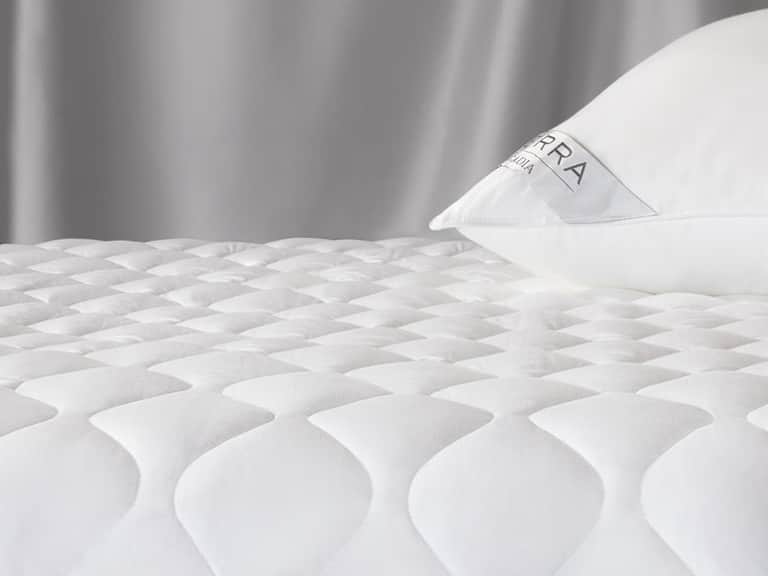
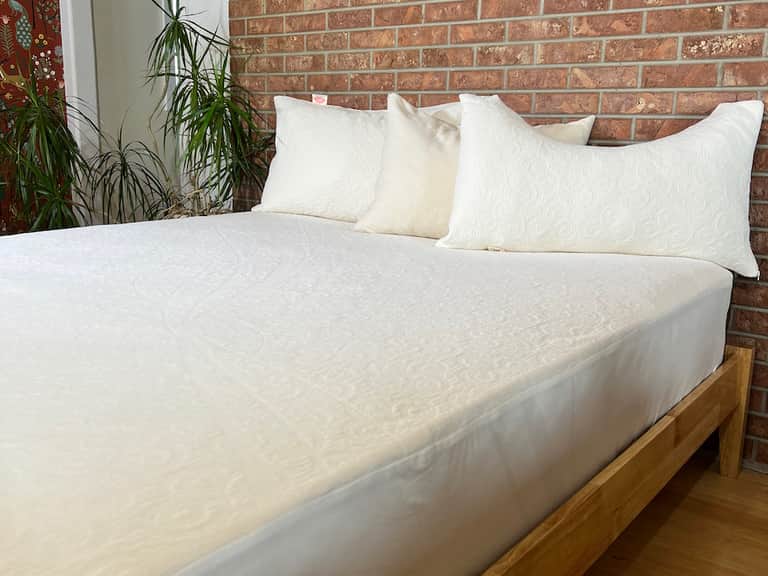
For parents comparing the Naturepedic options listed for crib bedding, the Naturepedic Waterproof Organic Cotton Crib Mattress Pad, flat style is described as a 28-by-52-inch layer with an organic cotton flannel top, cotton muslin bottom, and a thin waterproof inner membrane. A fitted alternative, the Naturepedic Waterproof Organic Cotton Crib Mattress Pad, fitted style, is also listed at 28 by 52 inches and has elastic around the perimeter. Those descriptions provide useful details to verify, not a substitute for checking compatibility and safe-use directions for your own crib and mattress.
Organic cotton: a question of feel and finish
Organic cotton is often appealing in nursery bedding because it is a familiar natural fiber with a soft, tactile quality. In a crib pad, the surface fabric may be flannel, which has a gently brushed feel, while a muslin layer can provide a lighter woven backing. The precise hand depends on the weave, finishing, and construction; “organic” alone does not tell you whether a fabric will feel crisp, smooth, plush, or cool.
Certifications can help clarify how a textile was assessed, but readers should look at the specific certification and what it covers. A certification related to fiber or textile processing is not a promise that a product will suit every household, nor does it replace a fit check or safe-use review. Read the product label and supporting documentation, and avoid assuming that a single material claim answers every question about the finished item.
Breathability is another commonly discussed quality. The feel of a textile and the airflow through a whole sleep setup are influenced by several elements: the mattress, the fitted sheet, the pad’s construction, and the room environment. A waterproof membrane may be designed to block liquid while allowing some water vapor to pass, but that description should not be taken as a guarantee of a particular temperature or sleep outcome. For a nursery, prioritize manufacturer guidance and a suitable room temperature over marketing language about cooling or comfort.
Flat or fitted: understand the difference
The design of a crib pad affects how it is positioned and what you need to check before use. A flat style lies on the mattress rather than stretching over its sides. The Naturepedic flat pad described in the product information is intended to be layered under a crib sheet. If considering any flat layer, follow the product’s complete instructions and confirm with the mattress manufacturer that the combination is appropriate. The sheet must fit snugly, and the sleep surface must remain firm and flat without bunching, gaps, or added softness.
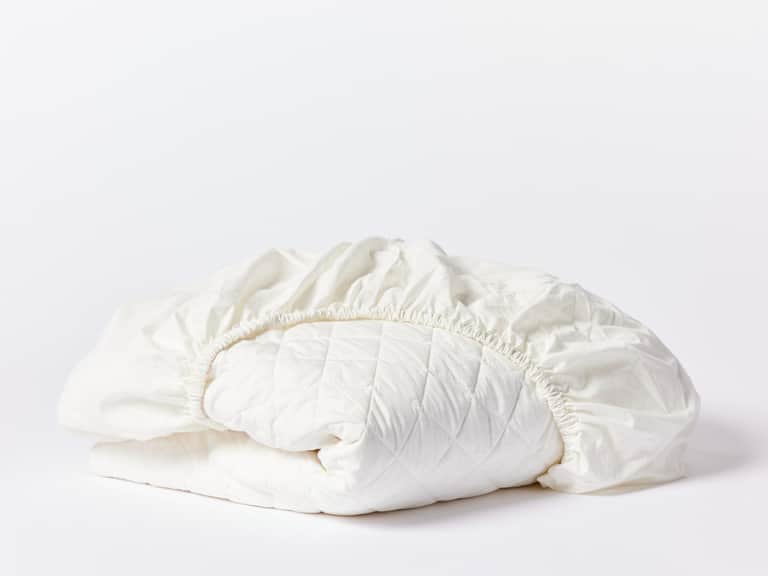
A fitted style uses elastic around the edge to hold the pad against the mattress. The Naturepedic fitted version is described as having elastic all the way around, which can help it stay in position when correctly sized. But “fitted” is not synonymous with “fits every crib.” Mattress dimensions, thickness, and corner shape differ. Check the stated size against the actual mattress measurements, then inspect the finished fit around every side and corner. Fabric that pulls loose, gathers noticeably, or leaves an exposed gap deserves attention before the crib is used.
In both cases, the goal is a neat, stable surface—not a thick, pillowy layer. Avoid doubling up pads or placing several absorbent layers under a sheet unless the manufacturers specifically say the arrangement is suitable. If the setup feels complicated, choose the simplest configuration recommended for the mattress and crib.
Fit is an everyday comfort detail
Fit is the unassuming feature that can make bedding feel considered. A well-matched pad is easier to position, less likely to shift during ordinary sheet changes, and more straightforward to inspect. Start by identifying the crib mattress size and measuring its length, width, and depth. Compare those measurements with the item’s specifications rather than relying on a general label such as “standard crib.” If the mattress has rounded corners or an unusual profile, take that into account as well.
Once the pad is on the mattress, look carefully around the perimeter. The edges should lie as intended by the product design, and the fitted sheet should go on without forcing, stretching excessively, or creating loose folds. Check the corners and sides each time you change bedding. If an item has shrunk, stretched, or changed shape after laundering, reassess whether it still fits securely; do not rely on the appearance of the center alone.
Fit also has a maintenance dimension. A pad that is easy to remove and replace is more likely to be cared for as directed. Before the first use, inspect seams, elastic, and the waterproof layer, and read the full care label. The product descriptions for these Naturepedic crib pads specify machine washing and drying, but the label accompanying the exact item should be treated as the final word, particularly if instructions are updated or differ by product version.
A washing routine that works in real life
Nursery bedding benefits from a care routine that is simple, consistent, and guided by the manufacturer. Keep the label accessible or note the instructions somewhere convenient. For the Naturepedic crib pads described here, the listed care is machine wash and dry. Check the item’s label for temperature, cycle, detergent, and drying details before choosing a setting. Do not assume that a waterproof layer can tolerate high heat simply because the cotton surface can be washed.
Use only the cleaning products and methods permitted by the care instructions. Bleach, fabric softener, stain removers, and high-heat drying can affect fibers or coatings, depending on the construction. If the label advises against a particular product, resist the temptation to use it for a stubborn mark. Rinse and dry bedding thoroughly before putting it back on the mattress, and make sure it has returned to its intended shape.
It can be useful to have a spare fitted sheet on hand so the mattress can be made up promptly after laundry. That does not mean adding layers to the crib: the priority remains a correctly fitted sheet and a clear sleep space, in line with current guidance. Keep the bedding rotation modest and store clean pieces dry, away from dampness and strong odors.
For waterproof bedding, occasional inspection is as important as washing. Look for peeling, cracks, separation between layers, damaged elastic, or a surface that no longer lies evenly. A protector can only perform as intended while its construction remains intact. Replace an item that is damaged or no longer fits securely, and consult the manufacturer if you are uncertain about its condition.
Protection without unnecessary complexity
Waterproofing can be a practical feature when a household wants help guarding a mattress against moisture. The Naturepedic crib pad descriptions identify a thin waterproof membrane between cotton layers. That construction is different from a bulky, cushioned topper, but its presence still makes fit, condition, and manufacturer instructions important. A protective layer should not be treated as a reason to add other bedding or to overlook the need for a clean, properly fitted sleep surface.
Think of the pad as one component in a larger care system. A correctly sized mattress, a snug fitted sheet, and a laundering routine that follows the labels all contribute to an orderly nursery. No pad can eliminate every stain, guarantee a particular sleep experience, or replace appropriate supervision and safe-sleep practices. Keep expectations specific: protection is a material function, while comfort and suitability depend on the complete setup.
How to assess a product description
When shopping, it helps to read beyond a product name. Look for the exact measurements, fiber composition, construction details, care instructions, and the mattress depth or dimensions the item is designed to accommodate. For crib bedding, the intended use should be explicit. If a listing is unclear about whether a product is a fitted pad, a flat pad, or a protector, ask the manufacturer or retailer before purchase.
Pay attention to the language used for material claims. “Organic cotton” describes a material attribute, while “waterproof” describes a performance feature; neither phrase, by itself, explains how the item fits or how it should be used. Certification names should be checked against the product’s documentation, and safety-related claims should be assessed carefully rather than accepted as a substitute for official guidance.
For a Naturepedic crib bedding decision, a short checklist can bring the important details into focus:
- Confirm the crib mattress dimensions and compare them with the pad’s stated size.
- Check that the product is designed for a crib mattress, not an adult bed or general-purpose use.
- Read the mattress and crib instructions alongside the pad’s use and care directions.
- Choose a construction and fit that leave the sleep surface firm, flat, and secure.
- Follow the care label and inspect the fabric, seams, elastic, and waterproof layer regularly.
- Consult current safe-sleep guidance, especially if a product description leaves questions about layering.
A calmer nursery, built on good decisions
The most appealing nursery is not necessarily the one with the most elaborate bedding. It is the one where each item earns its place. Soft cotton, a dependable fit, and straightforward washing can make the daily rhythm of changing and refreshing bedding feel less fussy. But in an infant sleep space, visual softness should never become an invitation to add loose blankets, pillows, or unapproved cushioning.
Naturepedic crib bedding can be considered through those practical lenses: material, construction, dimensions, and care. The listed flat and fitted waterproof organic cotton crib pads offer different formats, and their product descriptions provide a starting point for comparison. The final decision should be based on the exact mattress, complete manufacturer instructions, and current safe-sleep recommendations—not on a broad assumption that one style suits every crib.
Choose deliberately, measure rather than guess, and keep the care routine uncomplicated. In a nursery, that kind of quiet precision is its own form of comfort: a sleep space that looks composed because its essentials have been chosen with attention, and maintained with the same care.
Frequently asked questions
What should I check before using a Naturepedic crib pad?
Verify that the product is intended for a crib mattress, compare its dimensions with the mattress, and read the crib, mattress, and pad instructions. Make sure the finished setup remains firm, flat, and securely fitted. Follow current safe-sleep guidance and ask the manufacturer if directions about layering are unclear.
Is a flat crib pad different from a fitted crib pad?
Yes. A flat pad rests on the mattress, while a fitted style is shaped to stretch over it and may use elastic around the edge. The product descriptions for the Naturepedic options list both formats. Neither format should be assumed suitable without checking its instructions, dimensions, and compatibility with the crib mattress.
How do I care for crib bedding?
Follow the specific care label on the item. The listed Naturepedic crib pads are described as machine washable and dryable, but the exact wash and drying settings should be confirmed on the product label. Avoid unapproved treatments and inspect the pad for damage or changes in fit after laundering.
Does organic cotton automatically mean a crib product is right for my baby?
No. Fiber choice is only one part of the decision. Intended use, fit, construction, care instructions, and compatibility with the mattress matter too. Review product documentation and established safe-sleep recommendations before making a choice.